Bend vs. Boise: Choosing Your High Desert Home
If you are looking to escape the rain of the I-5 corridor or the crowds of California, you’ve likely narrowed your search to the two heavyweights of the Pacific Northwest high desert: Bend, Oregon, and Boise, Idaho.
At a glance, they look remarkably similar. Both cities offer dry climates, downtowns centered around a river, and real estate markets that have absolutely exploded over the last five years. But once you spend a week in each, you realize they are fundamentally different places.
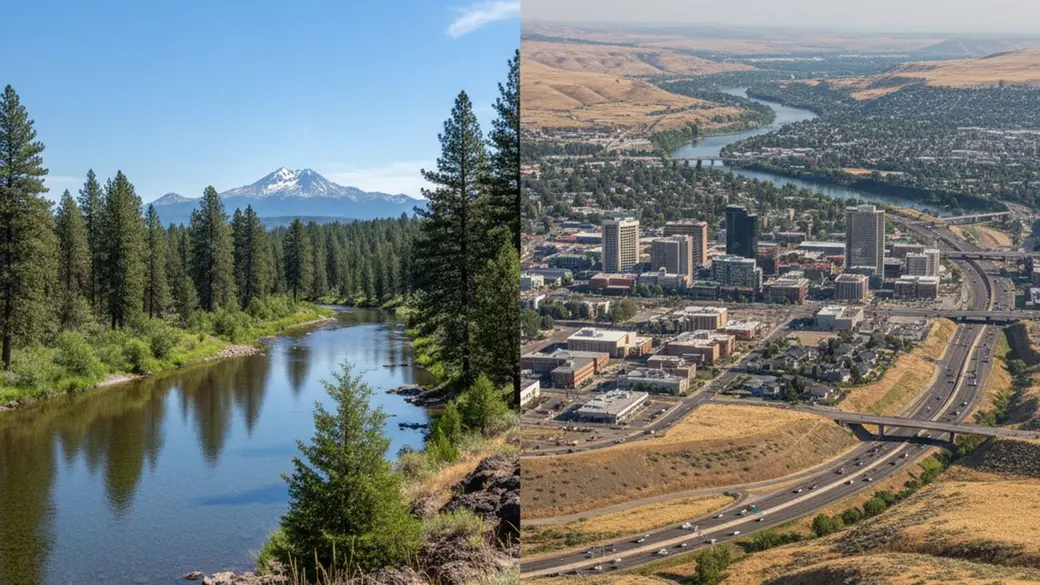
The core difference usually comes down to this: Bend feels like a luxury outdoor recreation town that happens to have residents, while Boise feels like a mid-sized metropolitan capital that happens to be near the mountains.
Scale plays a massive role here. Bend sits at a population of around 100,000 people and feels intimate. The Boise Metro area (the Treasure Valley) is pushing 800,000. That difference in size dictates everything from your commute to your dining options. Let’s break down the numbers and the vibes to help you decide where to plant your roots.
Cost of Living & Real Estate: The Price of Paradise
For most buyers, the decision starts with the monthly budget. While neither city is considered "cheap" anymore, there is a distinct price gap between Central Oregon and the Treasure Valley.
Let’s look at the housing market snapshot. As of January 2026, the median home price in Bend hovers between $680K and $735K. It is a competitive, high-equity market where entry-level often means a condo or a fixer-upper on the outskirts.
In contrast, the Boise median home price sits in the $490K to $505K range. That ~$200K gap in purchasing power is significant. In Boise, that difference gets you an extra bedroom, a newer build, or a location much closer to the city center.
When it comes to renting, the gap narrows slightly, but Boise generally remains more affordable for 1-2 bedroom apartments, simply because there is more inventory available in the larger metro area.
The Tax Triangle
Beyond the mortgage, you have to look at the "Tax Triangle"—income, sales, and property tax. This is where the math gets tricky depending on your income source.
-
Sales Tax: Oregon wins here with 0% sales tax. If you buy a car or new furniture in Bend, the price on the sticker is the price you pay. Idaho charges a 6% sales tax.
-
Income Tax: Idaho generally wins here with a lower flat tax structure. Oregon has a graduated income tax that is notably higher, especially for high earners.
-
Property Taxes: Idaho typically has lower property tax rates than Oregon, but keep in mind that with rising assessments in both states, your actual bill will depend heavily on the specific county and levy rates.
If you are moving to Bend, you are paying a premium for the location, whereas living in Boise offers a bit more breathing room in the monthly budget.
Job Market & Economy: Remote Hub vs. Industry Center
Once you’ve crunched the numbers on the house, you have to look at how you’ll pay for it. The economic engines of these two cities are vastly different.
Bend has a heavy reliance on tourism, healthcare, and service industries. However, a massive portion of the housing market is driven by remote workers bringing salaries from Seattle, the Bay Area, or Portland. If you need to find a local job in Bend that pays enough to afford the median home price, the options are more limited compared to a major metro.
Boise, on the other hand, is a true economic hub. As the state capital, it is anchored by state government jobs, major healthcare systems, and corporate headquarters like Micron and Simplot. The tech sector in the Treasure Valley is robust, offering local employment opportunities that don't rely on bringing a remote job with you.
This density brings a trade-off in traffic. Because the Treasure Valley sprawls across Boise, Meridian, Eagle, and Nampa, "rush hour" is a real thing. You will spend time on the connector. In Bend, congestion is increasing, but "traffic" usually just means waiting a few extra minutes at a roundabout or getting stuck behind an RV on 3rd Street.
Vibe Check: Mountain Resort vs. Capital City
What does a Tuesday night look like in these cities? This is where the "vibe" check is essential.
Bend feels like "vacation mode" is the default setting. The culture is incredibly casual. It is perfectly acceptable to wear trail running shoes to a nice dinner. The brewery culture is dominant, the town is exceptionally dog-friendly, and the pace is slower. The demographic tends to skew slightly older or wealthier, comprised of active retirees and established remote workers.
Boise feels like a city. It has a younger energy, largely thanks to Boise State University (BSU) right downtown. You have access to a wider variety of nightlife, diverse dining options, a symphony, and performing arts. While still casual compared to the East Coast, downtown Boise has a slightly more "buttoned-up" business feel during the workweek. It draws a lot of young professionals and households looking for that traditional suburban feel with city amenities.
Outdoor Access: Doorstep vs. Driveway
Everyone moving to the high desert says they want "access to nature," but that means something different in each city.
Bend offers the "Doorstep Advantage.": For many residents, the trail starts at the end of the paved road. You can float the Deschutes River right through the Old Mill District. Perhaps most importantly, Mt. Bachelor is only about 25 to 30 minutes from town. You can ski a half-day and be back for lunch. If you are a die-hard skier or mountain biker who wants to go every single day, Bend is hard to beat.
Boise offers the "Basecamp Advantage.": Boise is the launching pad. The Boise River Greenbelt is a world-class 25-mile paved path for cycling and walking right in town, and the foothills offer great trail networks. However, for big mountain adventure—like the Sawtooths or McCall—you are looking at a 2+ hour drive. Skiing at Bogus Basin is close and convenient (about 45 minutes up a winding road), but it is a smaller local hill compared to the destination resort status of Mt. Bachelor.
Climate Comparison: Inversions vs. Smoke
Both cities are High Desert, meaning you can expect low humidity, hot summers, and cool nights. However, there are two specific weather phenomena you need to know about before signing a contract.
The Boise Inversion: In the winter, the Treasure Valley is prone to inversions. This happens when cold air gets trapped in the valley floor by a layer of warm air above. It can create a gray, foggy "lid" over the city that lasts for days or even weeks, keeping temperatures cold and the sky gray.
The Bend Smoke Season: Bend is famous for its crisp, sunny winters. You will get more snow in town (approx. 20-24 inches annually vs. Boise's 18 inches), but the sun comes out immediately after. The downside in Bend is late summer. Wildfire risk in Central Oregon is real, and smoke from fires in the Cascades can settle into the Bend bowl, impacting air quality in August or September.
The Verdict: Who Wins?
There is no bad choice here, only the choice that fits your life stage and budget.
You should choose Bend if:
-
You are a remote worker bringing your own job.
-
You are a dedicated skier, snowboarder, or mountain biker who wants daily access.
-
You prefer a small-town, resort-style atmosphere over big-city energy.
-
Your housing budget can accommodate the $700K+ price point.
You should choose Boise if:
-
You need to find a local job in tech, government, or healthcare.
-
You want big-city amenities like a larger airport with more connections, shopping malls, and major concert venues.
-
You are prioritizing housing affordability and want more square footage for your money.
-
You want a traditional neighborhood feel with easy access to a university town culture.
Frequently Asked Questions
Is it cheaper to live in Bend, OR or Boise, ID?
Boise is generally cheaper, specifically regarding housing costs. The median home price in Boise is roughly $200,000 less than in Bend. However, you must weigh this against Idaho's income tax and sales tax, whereas Oregon has no sales tax but a higher income tax burden.
Which city has better weather, Bend or Boise?
This depends on your preference for winter sun versus summer heat. Boise has hotter summers but can get stuck in gray, foggy "inversions" during the winter. Bend has sunnier, crisp winters with more snow on the ground, but faces a higher risk of wildfire smoke impacting air quality in late summer.
Is the drive from Bend to Boise scenic?
Yes, the drive along Highway 20 is a classic high-desert road trip. It takes about 5 to 6 hours and passes through vast, open sagebrush plains and distinct geological features, though services are very limited between the cities.
Why are people moving from Boise to Bend (and vice versa)?
Migration flows both ways for different reasons. People often move from Boise to Bend seeking a smaller town feel, better access to premium skiing at Mt. Bachelor, and a milder summer climate. Conversely, people move from Bend to Boise to access a stronger local job market, lower housing costs, and more urban amenities.
Categories
Recent Posts